Let Him Do It

Everything was peaceful on the commercial Boeing 757 flight I took from Dallas last summer – until it wasn’t. Somewhere between the verse and refrain of a song I was listening to, I felt my body lift from my chair as the plan itself dropped in the air. My jaw clenched and my heart flew to my throat in fear. 

Glancing around me in panic, I noticed that the entire plane was in shock. Across the aisle, a young college student gripped her seat with white knuckles. The man next to me ripped the earbuds from his ears to listen frantically to the message from the caption over the loudspeaker. “I’m afraid!” children were screaming outloud as the plane took another dip downward. I felt the movement itself become faster than the gravity that held me to the seat.

The captain’s voice was muffled and sounded far away. He didn’t waste words: he ordered the flight attendants back to their seats for an “unexpected situation” with the weather. A glance out the nearest window revealed a wall of dark, grey clouds. I tried to fool myself with the idea of routine turbulence and instead, entered into what felt like the scene of a thriller movie. 

Our plane glided into the storm and as it did, I felt our steady climb into the sky descend in giant jolts downward. Our altitude, posted on the screen in front of me, was steadily dropping. The engines became quiet and the clouds seemed to swallow us into an unknown darkness. Every time the plane dropped, my heart sank a bit further into my throat.

The children’s screams escalated my own fear. “I’m afraid!” Their words were repeated, both aloud and in my heart. Every time the children screamed those chilling words, my own fear became more real within my heart. I wondered, perhaps the man, the college student, the flight attendants – perhaps all of us – wanted and needed to scream those same words: “I’m afraid!”

I knew those words inside of me were not meant to be quieted: I was meant to say them. But how? And to whom? I searched my heart and found Him, my God, recalling the words I had read just a few days before, shared by St. Margaret Mary, - words that he spoke both to her and now to me: “Let me do it.”

In a time of fear, panic, and terror, these words gave me peace. “He’s got me, no matter what happens,” I thought. There’s nothing I can do, nothing the man next to me could do, and so much that only the pilot could do. It was all in His hands. And he assured me, “Let me do it.”

Suddenly, my heart protested, “I’m afraid” it said with the children around me. Instead of quieting down those words and giving myself reasons to believe I need not be afraid, I leaned into the fear and said them over and over again to God in my heart. And so, this became a litany of prayer within my heart during those awful minutes that felt like hours.

Me: “I’m afraid.” Him: “Let me do it.”

Me: “I’m afraid.” Him: “Let me do it.” So it went, on and on…

The emotions inside me rose and fell, just like the plane itself. I had panic, then comfort; fear, then confidence.

It took about 10 minutes for the plane to right itself, and resume it’s steady course home. The relief I felt when the movement stopped was cautious. There was silence around me and all passengers seemed to be asking the same question, “Is it over?”

It was over. The captain returned to the speaker and said we had weathered the worst part of the storm. He ordered everyone to remain in our seats for the duration of the flight. While it took some time for the adrenaline inside me to subside and give way to relief and gratitude, I thought about the voices of the children, “I’m afraid!” while staring out at the dark clouds that paved our way home.

I admired how small children were able to articulate their panic with words and how they helped me to see the need I had to do the same and honor my fear. Children raised in a healthy environment have the privilege of being able to react and vocally respond to stimulus of all sorts, giving voice to fears as well as doubts, pain, and joys. I notice that as we grow, the healthy management of those emotions often becomes a misinterpreted and unhealthy suppression. How often do we convince ourselves that “there’s nothing to be afraid of” when in fact, there really is!?!? This experiencing highlighted for me this truth: trusting in God doesn’t mean we aren’t supposed to fear! The fear itself matters. You matter.

I believe that God Himself tells us so. He has historically acknowledged our fear – over and over again, much like the litany I prayed on that plane – and invites us to place it on Him, trusting that He will indeed “do it.”

“Do not be afraid…” He said it on the Sea of Galilee, on the mountain of the Transfiguration, and in countless other scriptural counts. “Fear not…” He said before ascending into Heaven and promising to return. He says it every day when he sees our response to danger or the unknown. He said it to Peter, He says it to me, and He says it to you.

Let Him acknowledge your suffering, my sister. Let Him comfort your fear. Give Him the space to say “I’ve got this” whether it’s once or one million times. He’s eager to do it and even more eager to come closer to you in those moments of fear. He will do it. We must only let Him.

Jesus said to St. Margaret Mary: “Let me do it.” “His Sacred Heart,” she wrote, “will do everything if I let him.”


A Place At the Table: Powered By Frozen, Overcooked Waffles

One New Year’s Eve, I received a call around midnight from a group of seminarians three states away. The unexpected nature of their call immediately led me to fear an emergency. When I heard joy and laughter upon answering the phone, my fear subsided and I soon learned the real the reason for their call: they were phoning in a favor. One of the seminarians had a college-age sister who wanted to attend the SEEK Conference in St. Louis that coming weekend. Her brother and the seminarians were willing to drive her to St. Louis the next day, but they needed to find a place for her to stay.

The young lady found a home on my couch the following night. Her seminarian brother – and his seminarian brothers – returned early in the morning to bring her to the conference. When they arrived at 7:00 a.m. to pick her up, I just finished making her a hearty breakfast, using the last of the ingredients I had in my refrigerator.

As I poured coffee for the men around my kitchen table, I noticed that some were eyeing the little sister’s eggs with interest. I knew full well that I didn’t have enough groceries to make them the same meal I prepared for her. And yet, I couldn’t help myself! The words slipped off my tongue, “Would you like some breakfast?”

In no time, I was raiding my pantry and asking the Lord to work another miracle of the loaves and fishes. He answered in the form of frozen waffles which I proceeded to overcook in an overheated oven. The men drowned the waffles in butter and syrup, devouring the entire stack while sitting at my table and bringing life-filled conversation and joy to the morning. To me, the waffles were a sad excuse for serving guests in my home. But to the men around my table, the waffles on their plate gave them a place of home at my table.

It did my heart good to see them off that morning to experience time with the Lord and each other – powered by frozen, overcooked waffles. Since that day, my home has seen guests that include seminarians’ sisters and even their mothers. It’s not something I ever offered to my seminarian friends outright. Yet, they have the freedom to ask, and their families have in some ways, become like my own.

That particular experience taught me a lot about hospitality – and it’s not about the art of entertainment, decluttering, hacks for hostessing, or stocking up on food in the pantry. Instead, I learned about the importance of having a place at the table and what it means to be a guest.

In fact, I’ve learned a lot about hospitality over the years by being a guest in the homes of others. Here are a few things I’ve noticed about being a guest:

  • It’s not about the food, it’s about the company!
  • Washing dishes can lead to the most memorable conversations and singing parties.
  • There are always more laughs and more memories around making the meal together than eating it.
  • Your uncleaned bathroom makes me feel at home. It’s just like mine!
  • I don’t care if the table is cluttered or sticky. I’ve often sat at tables where I could only claim a small corner so that everyone could fit around the table together. Those are the best places to belong.

The feminine heart was made with a capacity to receive. And the man’s heart was made in such a way as to desire to provide for others. Individually and united, men and women have a great power of hospitality that surpasses all forms of cultural entertainment, Instagram influencer accounts, and Martha Stewart magazines. Simply put: we were made for communion. Life lived with others is a life lived with Christ.

It’s not easy to overcome fear surrounding hospitality. Perhaps past experiences or cultural pressures have burdened our viewpoint of what it looks like to make room for another at our table. Today, I’d like to propose a few ideas and thoughts for consideration on this subject.

A Place at the Table of Your Home: Did you know? You can host others and enjoy the party! Often, I hear women speak of why they don’t host others in their home. They speak of messy houses, an unplanned menu, and a busy schedule. The secret to it all is this: it’s not about what you make or how you make it. (If that’s the case, find new guests!) Focus on the place you make for another at your table and let everything else be secondary. That very place you prepare for another is the most cherished part of the home. It says to its guest, “You are safe, you are loved, and you are wanted here. Come and rest awhile.”

A Place at the Table of Your Heart: Our home is the extension of our heart. We do not need to have to physically host others to show them they are known and loved. We can be a “home” for others and with others in our daily encounters – at work, with our children, at the grocery store, and best of all, with a community of friends and loved ones who offer life-giving relationships. Find your people and share life with your people – listening, loving, and fostering opportunities to receive and cherish others in your heart. You don’t even have to be with someone to make this kind of welcome. Your thoughts and prayers for them throughout the day is one way of listening to them with God.

A Place at the Table of Your Community: It doesn’t take much to notice a need for community in the world around us. A global pandemic continues to have an effect on social norms and fears. We’ve learned to live and do things alone. While independence has it’s value, it’s not an end-all! Chances are there is a widow, a single person, or a struggling parent who is longing for some kind eye to fall on his or her day. Practicing awareness to others and reaching out to them during our day has the potential of changing someone else’s for the better. What might seem like something so small as throwing salt on a neighbor’s icy sidewalk, smiling to a grocery store clerk, or entertaining small talk with an elderly woman in a waiting room actually cultivates a sense of belonging – both to the receiver and to you, the one who welcomes others to your table.

We were made for communion! I hope you’ll take some courage from these words and consider how you might make room for someone at your table, in your heart, or in your community this week. Know that just a you are worthy of “hosting” so are you worthy of being received and given your very own place at His table at Mass. I’ll find you there, in the Eucharist, where we share the greatest Feast of all.

Peace, Mary

Living from the tabernacle of my heart

We’ve been through a lot over the past several years and our lifestyle, culture, and habits have drastically changed. Among the numerous new considerations we’ve had to make for work, school, and health, there are also a host of new words. There is one in particular that I’ve been reflecting on these past few days: quarantine. I usually associate the word with isolation and loneliness, and rightly so. It means by very definition, “a state of isolation.” As I stop to consider how I’ve learned to cope with this and other negative effects of the pandemic, I see that I’ve learned a whole new way of life. Believe it or not, quarantine itself has strengthened and grown new and healthy “muscles” of connection that I never knew I had, leading me to a stronger, healthier understanding of a Eucharistic life.

A crippling snowstorm in the Midwest gave me pause to stop and realize I was automatically using these muscles. One morning, in the heart of the snowstorm, I walked from my home to Mass at the neighborhood church. A neighbor caught up with me in the empty streets. We took turns calling out when a car was approaching and saw each other safety to the church steps. Once inside, we unraveled our warm layers and looked about as others did the same. Monsignor was eagerly hearing confessions and preparing for Mass. The scene made me incredibly happy: the storm didn’t stop the normal activity, it actually enhanced it. “This is SO good,” my neighbor said as we entered the church. “It’s things like this that actually make us meet and spend time with one another!”

She was so right! It made me think about what “this” was. The news stations were describing “this” as a crippling and dangerous storm, one that was causing isolation, cancellations, and warnings. That’s when it hit me: covid, and all of its crippling effects, prepared me to not only cope differently in difficult times, but to actually live more fully from them. Ordinarily, I would have felt the crippling effects for the snowstorm deep inside my heart. Instead, I slipped into a routine that felt like home.

I caught up on rest, taking time to read, write, and pray within the natural rhythm of the day. I spoke to friends over the phone and did some work from home. I took night walks in the snow and shoveled my sidewalks and my neighbors’ sidewalks. Time was spent crafting, cooking, trip-planning and catching up on the latest happenings in a galaxy far far away. Friends came to dinner almost every evening. I quickly slipped into a healthy balance of housework and rest. I went sledding with friends. It was glorious!!

The simple truth is this: quarantine helped teach me that connection/communion with others is not contingent on being in the same room with them. One can live in a constant state of community and be completely alone in their heart, while another can live alone and be constantly ready for an encounter with others. The truth behind this is living a Eucharist life; a life lived in and from His presence.

The original quarantine of 2020 was pretty brutal for our world. Those were the days of ongoing isolation at home, scrubbing groceries before placing them on our pantry shelves, watching Mass via livestream, spending holidays with loved ones over video chat, and carefully selecting our social “bubbles.” Many of us got sick. Some even died. We spent days and weeks without access to the Mass, Communion, and even the chance to pray in our churches. Even now, some of us must continue some form of social distancing or isolation.

In the past two years, I had one major surgery and covid three times. Covid sent me to the hospital once and left me with ongoing health concerns. I’ve spent months being sick at home and then spent more months recovering afterward. In that time, I learned how to live more fully and freely from home alone, and how to seek and stay connected with others. I learned how to find His Presence in the Tabernacle of my heart. Those days have changed my life forever – and I couldn’t be more grateful.

I still don’t “do” quarantine very well. In fact, sometimes I get anxious just thinking about it. Complete isolation is never a good situation. I’ll be quite happy if I never have to quarantine again! And yet, as I learned with this snowstorm – I likely will. Life is out out of my control and I do not know what then future holds. But I do know that when those times come, I have an instinctive muscle that will help to see me through and can help strengthen my connection to peace at home and with others. I can dig deep into the Eucharistic Heart of Jesus and live from His presence.

This of course, is my muscle, strengthened by my personal experience. And yet I suspect that I’m not alone in this and that you have strengthened your own life through these very trying times in your own way, too. My neighbor’s reaction to the snowstorm tells me that she gets it: we’re not alone. No matter how hard or lonely the days may be, we are surrounded by invitations to embrace our life and the lives around us. This is what it means to live in communion – to live a Eucharistic life. “Come to me, all you who labor and are burdened, and I will give you rest.” MT 11:28

Honoring the Feminine Genius in Seminary Formation

It might be hard to believe given my silence on these pages over the past several months, but writing is a part of my everyday life. Most of what I write is either between me and God (journaling) or on behalf of someone (or something) else. Professionally, I write for various members of the Church on the topic of vocations and the formation of future priests. It is a great joy to share stories of the grace God is pouring out in the lives of good men discerning the call to configure their hearts after His priestly Heart. I love what I do, the people I work with, and the priesthood of Jesus Christ.

Recently, I was asked to write on behalf of the seminary in my own name about a topic (and people!) I am very passionate about: the Feminine Genius, specific to seminary formation. While I have witnessed first-hand the great impact women have in the daily lives of men as they discern the priesthood, for good, at this seminary, I have also witnessed and experienced the pain and disorder that come from misrepresenting, avoiding, and silencing these truths. So I accepted the invitation and wrote about what I see, what I hear, and what I know to be true about a woman’s heart and her great mission of receiving, nurturing, and caring for the souls entrusted to her care, specific to the environment of seminary formation. Here, just as in the rest of the world, the woman’s role is complementary to the man’s – and vice versa.

“Mary, am I a beloved son?” a seminarian asked me one day while he was standing at my cubicle. The look in his eyes told me that he was not seeking simple platitudes or comfort. Instead, he was searching my face for a sign of truth. I spoke his name and looked him clearly in the eye, “Yes. You are a Beloved Son of the Father.” A small smile came across his face, one that has continued to deepen and widen in the following months. His smile is priceless. There is a deep desire in my heart for this young man and every man in the seminary where I work to know the truth about who they are: beloved sons.

The article below is just a sample of the remarkable fruits of complementarity between men and women I witness every single day. In the six years of working at a seminary, I’ve witnessed countless men leave the seminary, some to discern God’s call elsewhere and others to become priests. I am proud of them all for opening their hearts to the healing Heart of Jesus Christ. I have also witnessed 92 men depart to lay prostrate before the altar on ordination day. I am hopeful for them, the women they will minister to, and the Church as a whole. There is healing and hope ahead for you, me, and the world, through the Priesthood of Jesus Christ and the women who stand at the foot of His cross.

Honoring the Feminine Genius in Seminary Formation, published in the Herald Magazine

Pray for priests! Pray for seminarians! Do not be afraid to be the women God created you to be.

Love, Mary

Pentecost: It is Good Not to be Alone

Children have a simple and direct way of making a home in a mother’s heart. I’ll never forget the day that 12-year-old Ian came into mine. He arrival was an unexpected surprise that changed my life. He was not the first to come – and I doubt he’ll be the last.

He came on a warm spring day on a coffee shop patio. I noticed that he was sitting by himself and wondered why a child of his age was alone on a Saturday afternoon. I had commandeered a table of my own with an umbrella and had planned to write out my grocery list while I sipped a matcha latte. Instead, as I returned to my table with the hot beverage, I found Ian sitting down next to my stack of papers. 

“Why, hello!” I said. 

“May I sit here?” He asked. 

“Certainly! I’d love the company. But please come and sit here in the shade.”

He grinned and sat in the chair next to mine under the shade of the umbrella. I watched as the boy consumed a seemingly endless procession of sweets and treats. While he ate, he told me all about his life – from his greatest achievements to his deepest insecurities. He was honest, innocent, and spunky. I found myself knowing his story, feeling his pain, empathizing with his desires, and wanting to be there to cheer him on throughout his entire life.

But instead, when the last bite of the sticky bun had been devoured, Ian stood up, wiped his sticky hands, looked me in the eye and announced, “Well, I’m going now. Thanks for letting me sit here with you… It is good not to be alone.”

A piece of my heart walked away with Ian on that day, as it walks away with all the others who take up a home within my heart. 

Home is a place where we are never alone; where one finds comfort, safety, and nourishment. This is motherhood! And it is built into the very identity of every woman, both spiritually and physically. St. Thomas Aquinas tells us that grace builds on nature. Blessed Virgin Mary is perhaps the perfect example of this kind of collaboration between grace and nature. 

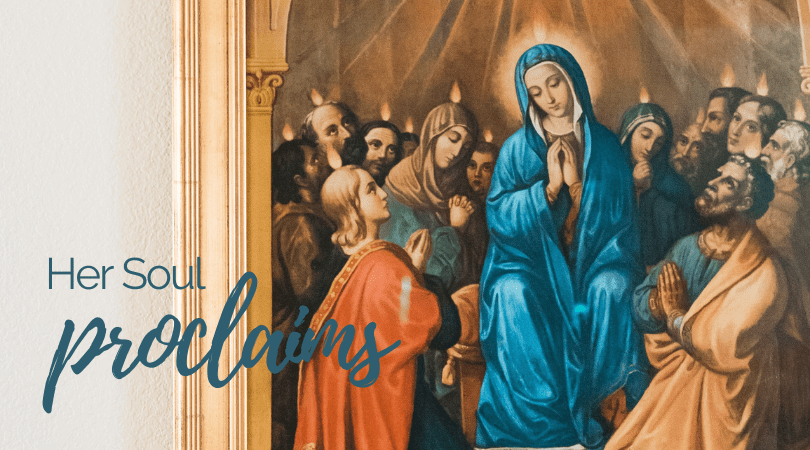
If motherhood is being a “home” for another, it is no surprise, that the Holy Spirit came to the Apostles as they were gathered together at home in the Upper Room with Mary. It makes sense that Mary would be present for the birth of the Church. In this way, the harmony of the spiritual family in the Church existed in this way since the very beginning. Mary was a home for the Apostles. She was a safe place for them to be themselves in a hostile world.

Mary was a mother, through and through. She waited and prepared with the Apostles for the coming of the Paraclete. She knew their story. She witnessed their zeal, received their blunders, wept over their persecution, and lingered in their longing. Her presence was real and it was all that was needed. She was not there to fix or provide, to heal or to facilitate. She was there to be present with her sons and daughters, as she is for us, for all eternity. With Mary, as Ian would say, “it is really good not to be alone.”

This is really all a child wants, right? To know that their mother is with them through everything?

“I am quite gifted,” Ian told me on that memorable day. “I’m really good at Math.” Some might shake their head at such a bodacious claim. I smiled, guessing that there was more. And sure enough – there was. After sharing more about his achievements, Ian suddenly got quiet and his face grew serious, “There are things I’m not very good at – like PE. And… I have autism.” In sharing this, Ian was sharing with me a vulnerable place in his heart. In that moment, Ian was a son. And he was home. He was safe and loved in my heart and his sufferings made me love him even more. Only the childlike can be so vulnerable and free. 

For Mary and for us, being a home for our children means experiencing life with them. The child’s joy becomes our joy and their sorrows becomes our sorrows. It is here, perhaps, where she is most a mother. Children want to be with their mother. They want to know that she sees, knows, and loves them. Like the baby who stops crying when he hears his mother’s voice, so are we comforted by our mother’s presence in any given situation. It’s easy to forget in the middle of diapers, night feedings, homework, and meal preparation. It’s hard to remember when we’re aching over the misfortunes and wounds of adult children, battling big lies and facing great fears. To a mother, it all matters. 

I knew Ian for only 45 minutes of this life, but I will treasure what I know for eternity. What Ian doesn’t know is that he will never be alone again. He is always at home in my heart. 

Mary our Mother, is indeed with us. She cares for us like she cared for the Apostles on that day in the upper room. She witnesses our zeal, receives our blunders, weeps over our persecution, and lingers in our longings, too. In this way, we see her showing us the first privilege of a mother in supporting, cultivating, and fostering her children spiritually and yet also, in a very real way. She wasn’t simply an observer – she received the Holy Spirit with her children. Her motherhood is, as the Preface of the Mass of Our Lady of the Cenacle tells us, “a oneness of mind and heart.”

What I experienced with Ian was a very real kind of spiritual motherhood that lives on and continues to bear fruit and love in my heart. The joy I experienced in our brief encounter helps me keep an open heart and table for whoever God sends me way. In being there for Ian, I found for myself the truth to his words: it is good not to be alone! I am not alone! Ian is always with me. I pray for him and sometimes find myself wondering what he’s doing. When I see a child riding a bike in the neighborhood, I often wonder – is that him? I see a school bus pass by and wonder, is he inside? Has he grown taller? Is he happy? Does he know that he’s loved? Please God, let him know he is loved! And I have to believe that the love and prayers he takes up in my life will bear fruit for him in a way that will only be fully known in Heaven.

Life and love are meant to be shared. Like Mary, every woman’s heart has the capacity to be given away, over and over again to the children who come and make it their home. In this way, God entrusts us to each other in special ways as family. And family sticks together, even if it’s just for a few minutes under the shade of an umbrella.

Do not be afraid to be open to life! Leave extra room at your table! You never know who might need a safe place in which to be loved and to love in return. It is, in fact, good not to be alone.

Love, Mary

“Every mystery of life has its origin in the heart.” – Hans von Balthasar

Where the watermelons grow

“Down by the baaaaayyyy, where the watermelons groooowwwww…”

The sound of this familiar tune came to my ears one evening while making a quick stop for Aldi essentials. The music came from the little boy sitting in the cart beside me. Far from holding back his vocal abilities, the little fellow was belting the song enthusiastically from his perch in the cart. His sandy yellow head moved to the motion of the music and his legs dangled from the seat. His eyes were closed as if enjoying the finest music from a concert stage.

“Back to my hooooome, I dare not goooooo….”

I looked around for the parents of this child, hoping to catch an eye and share a smile. They were there, but they were unaware of the concert at hand. In fact, they were engaged in their own concert of sorts – one unfortunately full of discord.

The parents were arguing.

“For if I doooooo, my mother will saaaaayyyyy…” he continued. The note of expectation in this phrase matched the need for resolve in his parents’ dispute.

The boy’s tone was steady and clear, and oh, so precious! In spite of the commotion his parents were making in that same aisle, I found my heart and mind fixed not on their argument, but on the boy. His message was clear and persistent: no one and nothing would stop this child from singing about The Bay.

He got louder. I waited for his mom or dad to disengage from their dispute to acknowledge the boy. Based on their mood, I half expected one of them to silence the child. But they didn’t; they ignored him completely. I was eager to finish the refrain with, “Did you ever see a llama, wearing a pajama?” or “Did you ever see a swan, waving a baton?” but the boy didn’t give me a chance. Instead, he launched into the refrain once again,

“Down by the baaaaayyyy, where the watermelons groooowwwww…”

His voice carried throughout the store, keeping me company while I finished my route. Over and over again, he sang the refrain, never once finishing the final sentence. As the cashier handed my receipt to me, I could see the father holding the boys hand on the way to the bathroom, his voice still echoing through the store, loud and clear.

As I left the store, his song in my heart, I found myself exploding with joy and sheer delight in the boy’s innocence and resilience. And at the same time, I found myself hurting for her – his mother.

“Oh, Mama… please don’t miss his song,” I prayed for his mother.

I could see her face in my memory: tired, worn out, and defeated. I could hear the irreverent words spoken to her husband in front the entire store in bursts of frustration and impatience. I could sense the hurt in her heart as equally irreverent words were spoken back to her by her spouse. With such a burden to bear, it seems that she couldn’t hear her son’s song. And then I realized: perhaps she wasn’t missing it at all. What if this was actually HER song from a happier day, now manifest in the son? This was, in fact, a song from home.

“My mother will say…”

And so, I took delight in the boy and his mother, thankful for the time she likely took to teach it to him. I prayed that she would soon scoop him up into her arms and tell him she loves him. I believed that she would once again sing the same song to him and tell him of home. And I resolved to be more like the boy himself, by singing loudly amidst a world of discord.

This sound of discord is forever in our ears. And right now, it seems to be the theme of the world around us. A culture of death knocks at the doors of our families, seeking to steal our memories, motivation, and morals. And yet – the song is not over. It’s only yet begun. The song of our Mother, the Church, is in our hearts. As baptized souls, our very identity is steeped in the music of a Love so great, it surpasses all other earthly loves. This song lies deep within our heart and we can, like this small boy, sing it boldly in the middle of a storm (or the dairy aisle at the grocery store!).

And the next time I stray far from The Bay, distracted by the discord around me, I pray there is someone who loves me, like this little boy, who will sing a mother’s song in my presence and call me back to who I am and the goodness around me. We can at any given moment, say “no” to the lies and distractions of the world and “yes” to the truth of who we really are and how much God loves us. Let’s be persistent and sing boldly! Ours is a song of home.

Let’s go home to The Bay, where the watermelons grow.

Yours, Mary

Demanding her kisses

There’s no doubt about it: children are demanding. 

A new mother would agree as she tirelessly spends all hours of the day learning and responding to her baby’s signs of hunger, fatigue, and discomfort – from the slightest whimper to the sudden wail.

A seasoned mother would also agree, looking back at a lifetime of hearing, “Mom!” shouted, whispered, cried, and exclaimed from big and little lungs throughout her every day.

Children are demanding. 

And yet – would you believe it? I think her child’s demands are secretly a mother’s greatest pleasure. As much as the demands themselves may take their toll on her energy and strength, it is their business that occupies her thoughts, prayers, and desires.

It’s her child’s cry that wakes a mother’s soul.

It’s her child’s need that reaches into the deepest recesses of her heart.

It’s her child’s desires that occupy her mind.

And it’s her child’s happiness and comfort that motivates her actions.

I know many new mothers who say they’ve never been happier, despite the lack of sleep. And I know many seasoned mothers who delight over a call or text message from an adult son or daughter, missing the days when her name was said more often.

While I don’t have biological children of my own, I can tell you quite decisively that it’s the demanding child who has captured my heart.

Let me introduce you to a demanding little boy who might catch your attention, too. I saw this little two or three year old boy a few weeks ago attending Mass with his parents and older siblings. He was glued to his mother for the entire Mass. If he wasn’t in her arms, he was by her side, his own little arms around her waist and his head leaning against her body as if leaning against a pillar inside the church itself. He was quite precious!

It was clear from the start that while he was trying to be still and quiet, he also had a lot of energy. So it wasn’t a complete surprise when he fell off the kneeler during the prayers for the faithful.

A loud wail echoed throughout the church, followed by a series of sniffles. The boy reached for his mother’s arms. She scooped him up and held him close. He cried and whimpered (most certainly over-reacting!) while she rubbed his back.

Suddenly, he pulled away and looked at his mother’s face with a pitiful expression. She gently kissed his cheek. He received her kiss, but did it seem completely comforted. It was clear that he wanted something more. I wondered if he wanted another kiss? I was right, he did! But he went a step further. He didn’t just want another kiss, he wanted one in a very specific place…

He wanted a kiss on his nose! He pointed to it and his mother instantly obliged. His little demand won his mother’s heart and mine. He knew how he needed his mother and he wasn’t bashful about asking – no, demanding! – her ability to provide comfort in a very specific way.

And his mother? This little boy’s good mother kissed his nose without hesitation.

Can you imagine the Child Jesus seeking love from His Mother in this way? I certainly can! I imagine Him holding on to her and being aware of her every move and action. I can even imagine Him demanding a kiss in the place where He hurt most. Who wouldn’t want to be near and cling to the Mother of all Mothers? And can you imagine how eager she was to receive Him and attend to His every need? She was, in fact, glued to His side, even at the foot of the cross.

Well now, here’s where the demanding child takes on new form in my own heart: I do believe that we are called to be the demanding child with Mary as our Mother. Of course she can fix our troubles, comfort our sorrows, and attend to our needs. But I also believe she wants to do all of that and more! She’s eager to receive us into her arms and kiss the exact places where it hurts most. She wants us to point to our nose, our eyes, our heart – and demand her motherly affection.

No doubt, Our Lord Himself did the same – and calls us to follow suit. I wouldn’t be surprised if there was a rather “demanding” child who sat at the foot of Our Lord when He said, “unless you turn and become like children, you will not enter the kingdom of heaven.“ MT 18:3

So this Advent, as we prepare for the birth of the the Baby in the manger, let’s learn how to see His Mother with His eyes. Let’s look up from the manger with Him and demand her loving attention and care, pointing to the very places where we need her most.

I do believe she will gladly and most readily oblige!

Yours, Mary

How I lost my friends to marriage

losing friends.jpgIt was a simple invite to play mini-golf from an unexpected number. I saw the familiar last name in the text message, but was surprised to see that instead of an invite from Faith (who was out of town) I was invited to spend time with her husband Paul and a few guy friends one weekend last summer.

The mini golf game was so enjoyable. As we began the game, Paul declared that the winner “gets to buy Mary’s dinner afterward.” (I think it was pretty clear from the start that I wasn’t going to win.)

I felt absolutely, positively loved that day by my friend’s husband. The memory of that day has become an ongoing place of gratitude in my heart, for this is just one of countless surprises that has come from “losing” my friends to marriage.

Yes. I have “lost” more friends to marriage than I can count. It’s been 15 years since my first childhood friend started dating her now-husband. Since then, I’ve stood beside (or in the choir loft) as one friend and sister after another said “I do” to the one man of their dreams.

To the young single woman who told me recently that she’s struggling with the idea of her best friend getting married this year, I get you. It can be difficult to watch a complete stranger waltz into the life of your friend and whisk her away to a new life and a new last name.

No matter how obliging or sacrificial a friend might be, the entire dating and marriage scene changes the priorities in our friendships. And there is a natural sense of insecurity to one outside of the relationship. The reality is – when your fiend gets married, things just won’t be the same.

And do you know what I say to that?

Thank goodness!!

This past decade has opened my heart to a whole new way of looking at the “loss” of friends in marriage. The days of meeting up for burgers after work on a weekday or enjoying a lazy Saturday afternoon together are over. Yet, they have ushered in new memories and moments I wouldn’t (and couldn’t!) live without.

There is no denying that my friends change when they get married. It’s something I’ve grown to understand and appreciate over time. They are, in fact, opening the great gift of their vocation and diving into a whole new world of relationship. Change is never a small word.

But the true-blue friends change in the best possible sense of the word. They become more of themselves. I see new places of surrender, sacrifice, and love pour from their lives and into their families. I see their best qualities become even better. I marvel at the ways they bravely maneuver all sorts of new territories, from in-laws on holidays and shared bank accounts to pregnancies, births, and miscarriages. These women show me what love looks like. And they welcome me into so many places of blessed messiness.

I learn through them that the struggle to trust in God’s timing and plan continues into marriage. They teach me that the need to overcome self-doubt continues into parenthood. And they point to my single life and show me that there’s nothing really solitary about it simply because they’re right there, beside me, welcoming me into their lives, homes, and families.

Their children call me “Aunt Mary” – even though I’m not technically their aunt. I get to watch tiny little people grow into smaller versions of my friends and their spouses. My musical repertoire includes rhythms with hand motions and my weekend Christmas schedule is often decided by which youngster is performing in a concert and when. Sometimes, in very special cases, I even get to share in the spiritual journey as a godmother.

IMG_9245.jpegTruth be told, I don’t know what I would do without my married friends and their families. Without them, I wouldn’t know just how imaginative children’s’ minds can be when telling scary stories around a bonfire. I might not be able to experience the sweet joy of a newborn’s restful weight on my chest as he sleeps. Or know what that baby’s first day is like in the hospital after she’s born.

With them, I know that it’s possible for a man to love a woman so much that he truly does lay down his life for her.

These good men do more than humor our friendships – they invest in them in a million different ways, making sacrifices and time for visits, nights out, and even adventures to foreign lands. I will never forget something my friend’s fiancé said to me when announcing their engagement and asking me to be in their wedding party, “Mary, we couldn’t imagine our wedding day without you.” I knew then that the joy that comes from sharing lives in different vocations was mutual. Because that’s exactly the way I feel about the men who marry my friends – I can’t imagine my life without them. 

So if you’ve ever wondered if a married and single friends can retain friendships beyond weddings, consider this and know that the bond between two women who share the same heart can grow, no matter how different their lives might look in the everyday. I believe it has something to do with our maternal mission as women, made for motherhood and by nature of the family, invited to sisterhood through it… much like Mary and St. Elizebeth. Perhaps Alice von Hildebrand says it best:

“A woman by her very nature is maternal — for every woman, whether … married or unmarried, is called upon to be a biological, psychological or spiritual mother — she knows intuitively that to give, to nurture, to care for others, to suffer with and for them.”

Want to grow your family? Embrace your single sister into your home – messiness and all! Or, lose your married friend for a minute so she can bring back something more.

Love, Mary

St. Therese: Your Big Sister and Mine

Copy of Blog.jpgMy little sister and I sat on the front step of our house in southern New Jersey like hot-pink marshmallowy children, dressed in puffy snowsuits and fluffy boots. It was cold! Our 4 and 2 year old personalities were shining in full force as Mom pointed the camcorder in our direction. I looked like I had the weight of the world on my shoulders. My sister sat next to me, exploring the snow stuck to her mittens.

The scene was set for what was – and still us – one of my favorite sister memories. (Shoutout to all moms who know how to whip out the camera at just the right minute! You prove that our memories are in fact, realities.)

“What’s wrong, Mary?” Mom asked as the camera revealed me seated with my head hanging low, over-exaggerating a melancholy mood. 

“I didn’t get to help Dad shovel the driveway. Katie got to help, but I didn’t get a chance to do it,” I responded with a heavy sigh. Mine was a pathetic attempt at true sorrow. As an adult, I watch the video today and wonder how my mother witheld a giggle and an, “Oh please…”

There wasn’t much time for my mom to respond as my sister decided to take the melancholy matter into her own hands – literally. With camera still rolling, baby Kate took her snow-covered mitten and flung it in my face, waving it about as if to make it snow again right before my eyes.

It was a 2-year-old’s way of trying to lift up my heart – no words necessary.

That simple act remains, to this day, the very heart of our relationship as sisters. Even in her littleness, she knew my heart was heavy about something that could be fixed with simply a change of attitude. And she took it upon herself to be the one to try and lift me up and out of the sadness. Although I didn’t jump up and leave my sorrows after her attempt to lift my spirit (melancholics need time, folks!) it made a difference. And always will.

My sister is my other self. We shared everything as children – our experiences (both good and bad), our friends, amusements, sports, you name it! The only things we had to ourselves were our ages and our closets (because I insisted). And as adults, we continue to share in each other’s lives in deeper, more powerful ways than I could ever imagine.

Our relationship has saved me on more than one occasion, from the time she physically stood up for me against bully neighbor boys, to the time she showed up with her husband at midnight to help jump my car in a snowstorm. Sisterhood is something as fierce as it is filled with love.

I share this story today on the feast of St. Therese of Lisieux for a reason. You see, I believe that the sisterhood I describe above is for every woman – whether you have a biological sister you can count on or not. St. Therese shows us how to embrace this relationship like none other. It is impossible to learn about the life of St. Therese without also learning about the sisterhood to which she belonged. As the youngest of 6 Martin girls, little Therese’s childhood survived on sisterhood. In her autobiography, St. Therese talks about her sisters in almost every human way possible, adoring some and even somewhat quarreling with others.

Therese and her sisters shared everything together as true sisters do, including the death of their mother. Therese turned to her sister in the shadow of this loss, it was her sister Pauline she chose to be her second mother. The Martin sisters even shared the call to the very same vocation, each of them becoming a religious sister.

The Little Flower made it her mission to take a shortcut or “elevator” to Heaven so she could shower us with God’s blessings. Is it not a surprise, then, that she would leave us with this promise, “I am your sister and your friend. Never will I cease watching over you.” 

If that’s not a “big sister” thing to say and do, I don’t know what is!

St. Therese might be the littlest sister in her earthly family, but she is for each of us, the best big sister we could ever have in our hearts. She sets the example and tone for our lives, going ahead of us to lift us out of a world of suffering (melancholic Marys included). She knew sisterhood well and I think, invites us to enter into it with each other. If she could reach me and my reluctancy, she can reach you, too.

When I became a Catholic in 1996, St. Therese was all the rage. Her story was the first saint story I read and as a result, I quickly decided she was going to be my Confirmation saint. Until I read the story of St. Rose of Lima… At that point, I decided St. Therese was too popular, anyway. Every girl in my class was choosing her. And they were all receiving roses as answers to their novenas! I decided to leave the fan-girling for everyone else and let St. Therese off the hook.

In spite of my reluctance, St. Therese found me after all. In fact, I think she was there all along like the sister she is, waiting for me to get over myself and wanting only to love me and show me something greater than my heart’s desires.

She wants this for you, too. And I believe she calls us to be there for each other in the same way.

Sisterhood has shown me the ways in which we are called to support one another as women – ways that our jobs, vocations, and even our call to spiritual motherhood cannot satisfy. A sisterhood is a place of vulnerability, where we are called to leave comparison at the doorstep and be present to each other in our best and worst moments. This kind of friendship supports, protects, and strengthens us in our vocations, calling us to holiness and assuring us that we are not alone.

A true sister, like St. Therese, walks with us in our times of sorrow, rejoices with us in our good fortune, affirms our identity in times of doubt, stands with us in adversity, and most importantly, calls us to holiness. Being better sisters makes us better mothers, daughters, and wives. A true sister sister simply shares everything. 

Except clothes. That’s where I draw the line. 🙂

If you do not have a sister to call today, go to St. Therese. Start with the best of big sisters and she will, no doubt, introduce you to others. She made it her business to shower you with roses, after all! If you have a sister (or more!) you share your experiences with, hug her a little tighter today and join me in resolving to treasure the person she is to you and the world around her.

Happy feast of St. Therese! 🌹

With love, Mary

Squinting my eyes for His camera

Copy of Blog.jpgOne year ago, I sat on the edge of the Grand Canyon and smiled so hard my eyes squinted for the camera. There, I gaped at the magnificent sight before me and marveled at the endless layers of stone, sand, and minerals that formed the endless range of mountains inside the earth’s crust.

I was not alone. Thousands of people joined me along the edge of the canyon that day. Some had cameras in hand, but most simply stood and gazed over the canyon, as if paralyzed by wonder. (It became clear to me then why Americans chose the Grand Canyon as the 8th Wonder of the Modern World, according to a USA Today’s November 2006 study.)

Geology was one of my greatest hobbies as a child and teenager, next to reading. My “rock collection” was embarrassingly extensive. And although I didn’t become the Geologist or Archaeologist as planned in grade school, I still have a habit of bending over to study rocks in along the road or pouring over the latest new story of an archaeological dig.

You see, I’m a big picture person who likes to dive into the details to discover how pieces work together to make a whole. I believe this explains my love of pilgrimage (the thousands of steps that make up one destination), my job in communications (studying the ways in which others perceive truth or an idea) and it even explains my love of ensemble music (two, three, four, and even 8 voice parts coming together to form the sound of the angels).

This way of thinking took on a whole new perspective at the Grand Canyon.

There, I stood at what might as well be the greatest geological treasure of the world and could neither dig into the details or grasp the big picture. It was all I could do to pick my jaw up off the ground.

I found it paralyzing in the best kind of way.

How many little details must come together to make this place so spectacular?  And how much bigger is the big picture than what my poor little eye can see?

The Grand Canyon challenged my vision and how I looked at the world right in front of me. There was no possible way I could take it all in with my human eye. The beauty extended beyond what I could fathom – the details, the “big picture.”  Even my peripheral vision was limited.  And although I could not see or understand the size of it all with my own two eyes, I simply trusted it was there – before me and below me.

Yes! Those massive mountain-like formations might be over a mile high and yet, unlike any other mountain range that invites us to look upwards, these “mountains” invite us to look beneath the surface. 

That is where my eyes began to connect with my heart.

My vision at the Grand Canyon was challenged because it wasn’t about seeing the details or the bigger picture; it was about taking delight in a sight beyond my understanding. It was about seeing the story from a new perspective.

I beheld greatness and was satisfied with the unknown.

jad-limcaco-JEq_2UJoTtg-unsplash.jpgThat statement is not something I can say for my life, and yet I think that’s the beauty the Grand Canyon continues to unfold for me to this day. My life is made up of hours, days, weeks, and years – layer upon layer of simple moments. It is tested by the fire of adversity, forged by the working of grace, and holds oh so many caverns of love to create a masterpiece that I cannot begin to see or understand. But God does. Because He is the Master behind those details. And He tries to show me the masterpiece of my life every day with a new, glorious view.

What if I could, right here and right now, behold the intricate layers of my own story and be satisfied with a lack of understanding? 

What if I could trust that the unknown canyons and crevices before me will, one day, be filled with light? 

What if I could take a moment and smile so hard my eyes squint for His camera?! 

Simply put – what if I could believe that God loves me more than what my poor little human eye can perceive?

Dear friend, a whole year has passed since I stood in this place. And I am only now beginning to unpack what could be perhaps the most important question of all. I invite you into this quest with me. Let’s pray to know not the intricacies of how God loves us, but the simplicity of how MUCH God loves.

Because it’s so much grander than we can imagine.

Yours, Mary